
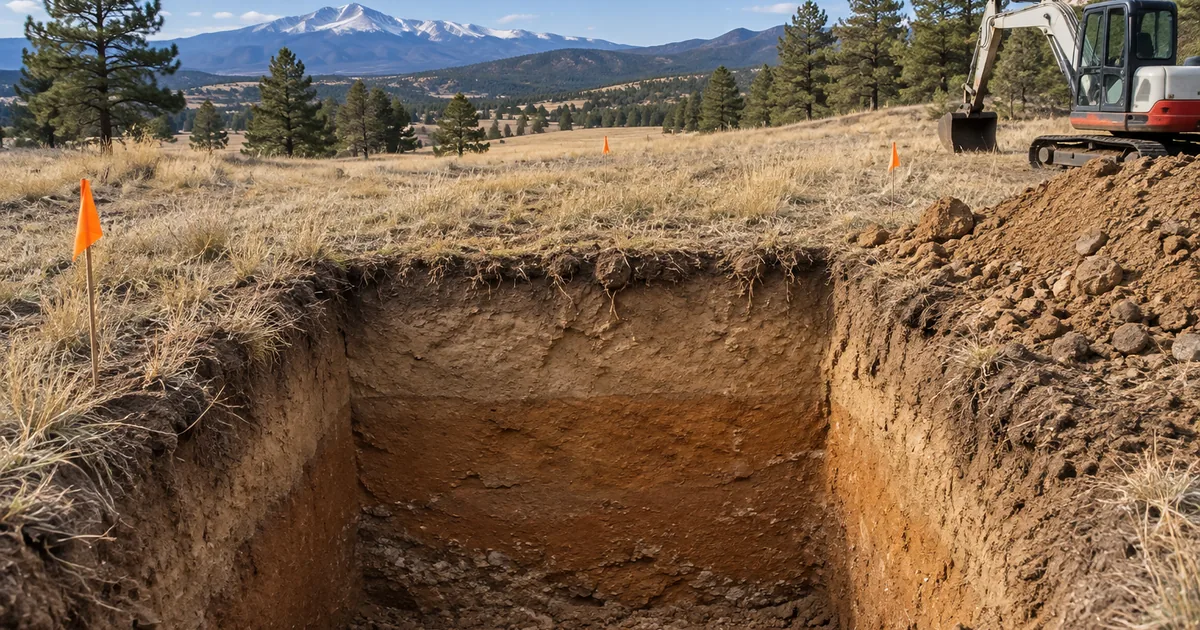
Before anyone designs a septic system for a Colorado property, someone has to answer a simple question: what is actually in the ground? The answer decides how big the leach field has to be, whether the design can be a basic gravity system or needs an engineer, and sometimes whether the spot you had in mind will work at all.
If you are planning a home or a replacement system in El Paso, Douglas, Teller or Elbert County, here is what a soil evaluation involves, what counties look for in the results, and what has changed in 2026.
Why the soil evaluation comes first
Colorado's statewide onsite wastewater rule, Regulation 43, requires a site and soil evaluation for every property where a septic system is proposed. It has four parts: a preliminary investigation (property records, existing wells, setbacks to water and other features), a site visit to look at slope, vegetation and land use, a detailed soil investigation, and a written report with a site plan.
That report is not optional paperwork. The state's minimum permit application requirements include the soil evaluation report and a system design with a site plan, and your county health agency reviews both. Counties adopt their own regulations on top of the state minimums, so details differ from county to county. The sequence, though, is the same everywhere: soil first, design second, permit third.
Profile pits: the part that matters most
The core of the evaluation is the soil profile test pit. The state rule calls for at least two pits in the area where the soil treatment area (the leach field) is proposed, with at least one dug in the part of the area expected to have the most limiting conditions. Each pit goes down to a limiting layer, a groundwater condition, or four feet below the proposed infiltrative surface, whichever comes first.
What the evaluator records in each pit:
- Soil horizons. The depth, texture and structure of each layer, from topsoil down.
- Depth to bedrock. Shallow rock limits where and how a system can be built.
- Signs of periodic saturation. Mottled colors and other indicators show where groundwater rises in wet seasons, even if the pit is dry the day you dig it.
- Cemented or restrictive layers. Dense, hardened layers are graded by how much force it takes to break a clod, and strongly cemented layers count as restrictive.
Two practical details are worth knowing. The soil has to be examined in good light and in an unfrozen state, which is one reason winter can complicate this step. And the pits are dug before any percolation testing, because the soil has to look suitable before a perc test is worth running.
This is the work we do on every new system: we dig the profile pits, analyze the soil, and turn the results into an engineered plan.
Percolation tests: a supporting role
A lot of people assume the "perc test" is the whole story. Under Regulation 43, percolation testing is something that may be added to the pit evaluation to give more information, not a replacement for it. Teller County's version of the rule goes further and says its agency will not accept a perc test alone without a profile pit evaluation.
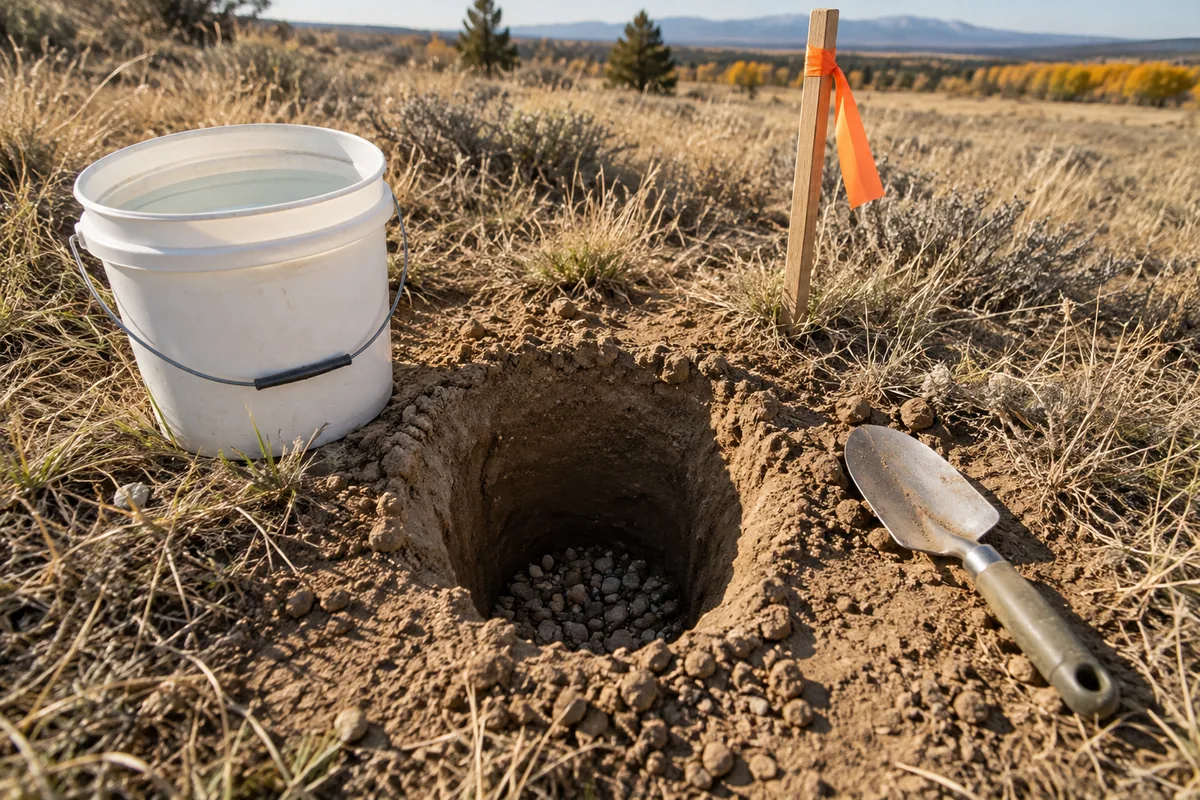
When a perc test is used, the rule sets out how it must be done:
- At least three test holes, spaced evenly across the proposed area.
- Holes eight to twelve inches across, with gravel placed in the bottom to prevent scouring.
- A presoak of at least four hours, preferably overnight, so the soil swells the way it will in the wettest season. In most soils the rate is measured the next day.
The test is done by a professional engineer, a trained person working under an engineer, or a competent technician. If the pit evaluation and the perc test point to different soil classifications, the designer has to use the more restrictive one. That is why a single lucky perc result on a good day cannot talk a poor soil into a smaller field.
What the results decide
The soil is sorted into types, from coarse sands to tight clays, and each type has a long-term acceptance rate: how many gallons per day a square foot of soil can take for the long haul. The soil treatment area is sized by dividing the design flow by that rate.
Here is how much that matters. A three-bedroom home is designed for 450 gallons per day under the state rule. For a sandy loam with moderate structure, the table value for ordinary septic tank effluent is 0.6 gallons per day per square foot, which works out to about 750 square feet of infiltrative area before any size adjustments. For a sandy clay loam, the value drops to 0.35, and the same house needs roughly 1,290 square feet. Same house, same family, very different field.
The soil type also decides who has to design the system. Regulation 43 requires a professional engineer for tighter soil types, for soils with high rock content, for sites where a limiting layer or groundwater is within four feet of the proposed infiltrative surface, for ground sloping more than thirty percent, and in several other situations. Counties can be stricter than the state on some of these, so check with your county.
Local soils and 2026 changes
Soils change fast along the Front Range. A published USDA description of the Peyton soil series, which shares its name with the community where our office is, describes sandy loam topsoil over a sandy clay loam subsoil with clay films, formed from granite-derived (arkosic) alluvial fan material. In that typical profile the clay-bearing layer starts only about nine inches down. That is a useful reminder of why the answer can change within a single lot, and why a neighbor's results tell you very little about yours. Published maps are a starting point. The pits are what count.
In Teller County, rock and slope are more often part of the conversation, and rock-heavy soils fall into the categories that require an engineered design.
Every Colorado county had to adopt a local rule at least as stringent as the updated state regulation by June 15, 2026, so several of the rules your designer works under are new this year. Two items are especially relevant to soil work:
- El Paso County. The revised regulations took effect July 11, 2026. The health department says soil reports lacking updated details will be accepted through December 2026, but beginning January 1, 2027, reports must include cementation information or revisions will be required.
- Douglas County. Its regulation, effective April 26, 2026, says a soil investigation is good for twelve months from the date of the initial evaluation, so an old report may not carry over.
How to prepare for the pit crew
- Walk the lot and note wells, cisterns, buried lines and drainage paths, including those on neighboring land.
- Keep vehicles and equipment off the area where the leach field might go. Compaction hurts soil performance.
- Sketch where the house, driveway and any future shed or addition will sit.
- Tell us whether you already have a soil report or permit, so we can check it rather than repeat it.
Frequently Asked Questions
Do I always need a percolation test?
Not necessarily. The state rule makes the profile pit evaluation the required part and treats percolation testing as optional added information. Some counties and designers use both, so ask your county what it expects.
Can I reuse an old soil report?
Sometimes. State rules let the local health agency decide whether to accept soils data collected earlier, and the state recommends verifying it with at least one new profile pit. Douglas County limits a soil investigation to twelve months.
What if the soil on my lot is poor?
Poor soil rarely means no system. It usually means a larger field, a different design, or an engineered approach. The pits tell us which of those applies before you commit to a plan.
Can soil testing happen in winter?
The rule requires soil to be evaluated in an unfrozen state, so a hard freeze can delay the pits. A mild winter may not. Weather decides, which is why it helps to start the conversation early.
If you are planning a new system or replacement in El Paso, Douglas, Teller or Elbert County, contact us and tell us about your property. You can request a quote through our contact page, and we will talk through the soil work, the plan and the county permit.